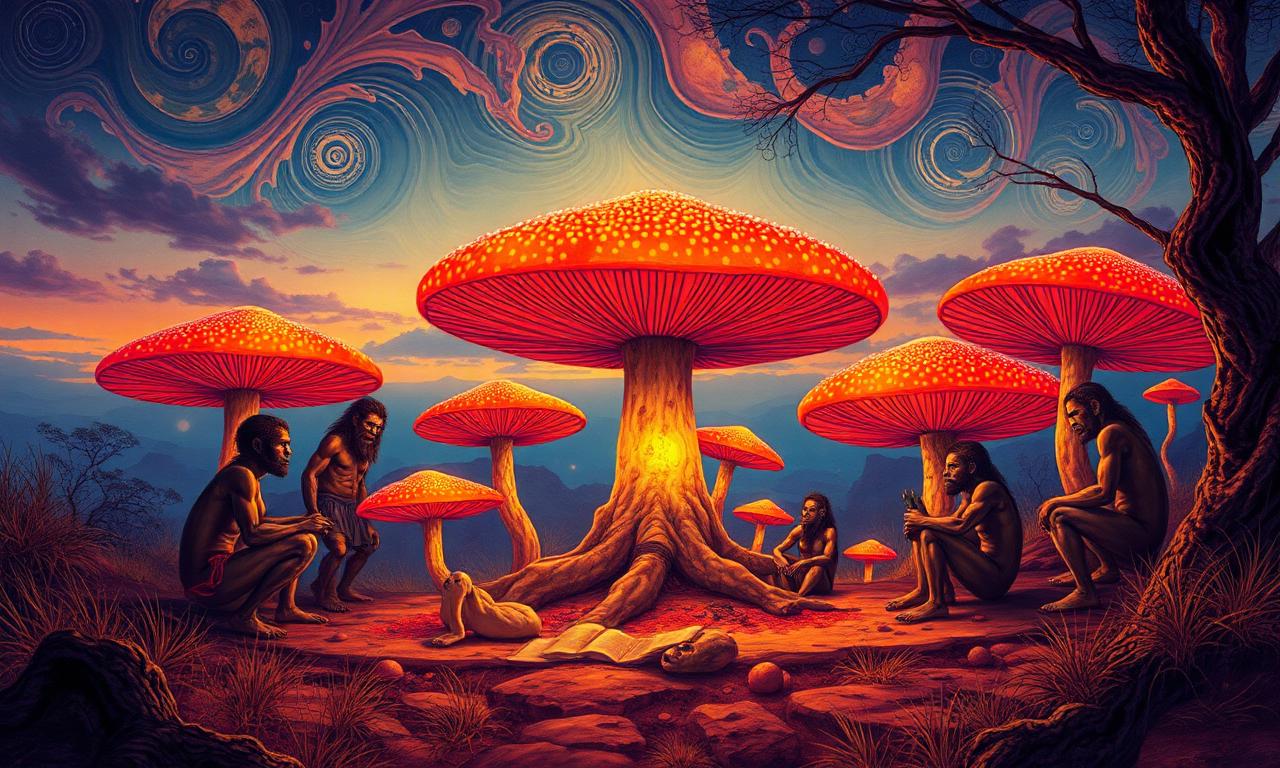
Picture a band of early hominids on the drying African savanna. The forests are shrinking. The herds are moving. Following the herds, our ancestors stumble onto something new — bright caps of psilocybe mushrooms sprouting from the dung of grazing animals. Hungry, curious, they eat them.
This is where Terence McKenna pours another log on the fire. In Food of the Gods (1992), the ethnobotanist proposed that low doses of psilocybin sharpened visual acuity — useful for hunters. Larger doses dissolved ego, loosened the tongue, ignited the imagination. Over thousands of generations, McKenna argued, the mushroom became a quiet co-author of the human mind.
A psychedelic catalyst
Modern science has not confirmed it. Most anthropologists are politely skeptical, noting that brain expansion began long before any plausible mushroom encounter. And yet the theory keeps glowing at the edge of the campfire — because it asks a question we cannot quite answer: what made us turn so suddenly toward language, art, music, and gods?
“We didn't fall out of the trees and grab a chisel and start chipping at the Venus of Willendorf. There must have been a catalyst.”
Why the story endures
Whether or not psilocybin literally rewired our ancestors, the Stoned Ape Theory points at a real mystery. Consciousness is strange. Symbol-making is strange. Standing upright on a grass plain and inventing music is very strange indeed. McKenna's gift was to insist that the strangeness deserves a strange answer — and to remind us that plants and fungi have always been our companions, not our backdrop.
Tend the sources
- McKenna, Food of the Gods (1992)
- Smithsonian: Mushrooms, Magic and Consciousness
Smoke signals · watch the fire
- Terence McKenna — The Stoned Ape TheoryTerence McKenna archives
- Paul Stamets on the Stoned Ape Hypothesis (JRE clip)JRE Clips
- Did Mushrooms Make Us Human?PBS Eons / Aperture
Links open a YouTube search so the fire keeps burning even if a single video gets taken down.
Around this fire
0 logs · 0 voices
Listening for voices…