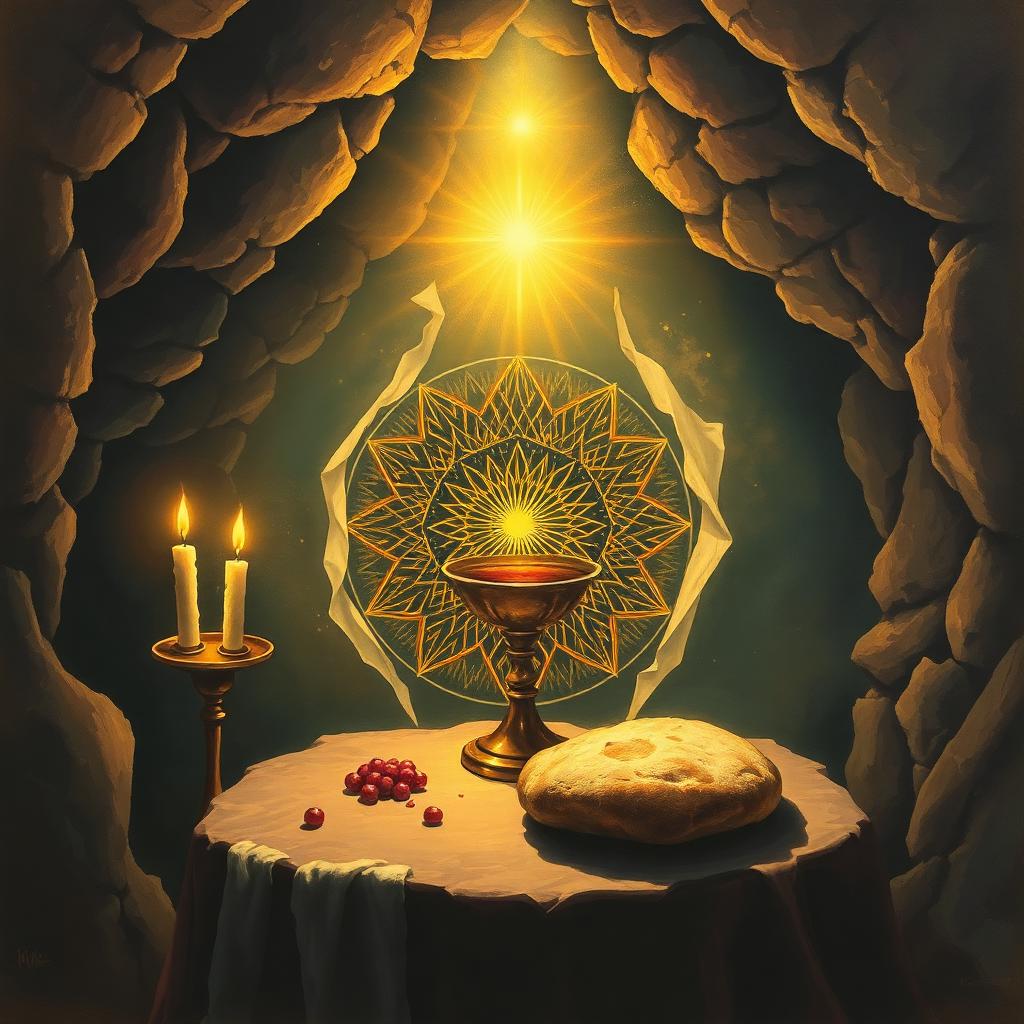
Brian Muraresku's The Immortality Key makes a startling claim. The Eleusinian Mysteries, suppressed in 392 CE by the Christian emperor Theodosius, did not simply die. They went underground. And they may have re-emerged, in a quieter form, at the earliest Christian altars — in the wine of the Eucharist.
The argument relies on a thread of archaeological chemistry. At a Greek colony in Catalonia, a chalice was found with residues of beer spiked with ergot and other psychoactive plants. At a Roman house-church near Pompeii, a similar pharmacological pantry. Early Christianity grew up inside Greek-speaking, mystery-cult-soaked cities. The first communicants would have known exactly what a sacred drink was supposed to do.
The mass that worked
Read this way, the gospel's promise — 'whoever drinks this wine will have eternal life' — stops sounding like metaphor and starts sounding like a recipe. A direct, visionary encounter with the risen Christ, available to anyone who showed up on Sunday. No bishop required.
“The Eucharist was once the most powerful drug in the Mediterranean. Then it was not.”
The orthodoxy that replaced it
By the fourth century, the visionary wine was being replaced — quietly, then loudly — with unadulterated bread and grape juice. The mystery moved inside the priest, who alone could perform it. Heresy hunts targeted, among others, women who brewed sacred drinks. Whether or not the original Eucharist was a true psychedelic, the institution that replaced it spent a thousand years making sure no one else could find out.
Tend the sources
- Muraresku, The Immortality Key (2020)
- Ruck, Hoffman, González Celdrán, Mushrooms, Myth & Mithras (2011)
Smoke signals · watch the fire
- Brian Muraresku & Graham Hancock on the Psychedelic EucharistJRE / London Real
- Was Early Christianity a Psychedelic Religion?Religion explainer
- Carl Ruck on the Pagan Continuity HypothesisLecture
Links open a YouTube search so the fire keeps burning even if a single video gets taken down.
Around this fire
0 logs · 0 voices
Listening for voices…